1.1 Background
Warming due to anthropogenic climate change is amplified at northern latitudes with profound implications for Northern communities, ecosystems, and socio-economic development. This points to an acute need to improve resilience to climate change in the Canadian North1, particularly in light of factors such as remoteness and the dependence on cold-climate-based infrastructure and cold-climate cultural traditions. There is an increased demand at national and provincial levels for putting in place structures for weather, water, ice, and climate (WWIC) services that aims at supporting stakeholders in building their resilience and adaptive capacity to address climate change risks.
[1] For the purposes of this project, “the North” or “northern” is used in the context of where the terrain is caracterised by extended periods of freezing temperatures and associated environmental conditions. Administratively, northern Canada, or “the North,” consists of the three territories – Yukon, Northwest Territories, and Nunavut as well as Nunavik and Nunatsiavut. In this project, however, a broader context for “the North” will be inclusive of transboundary datasets that may encompass northern areas of the other provinces that are not traditionally included as “the North”.
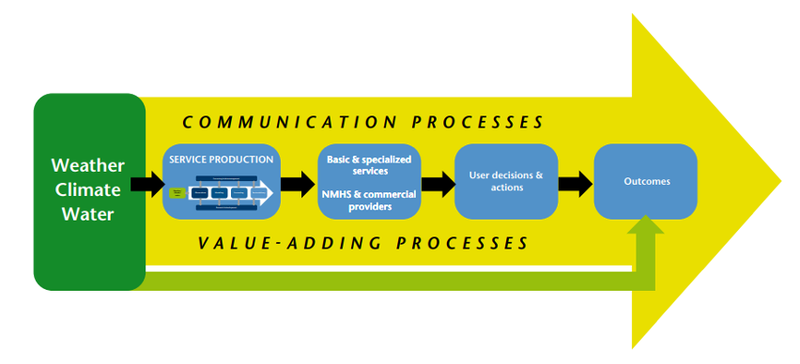
Climate services are often described as the bridge between climate data developers, whose work focuses on advancing science and knowledge of the climate system, and climate data users. The starting point of this bridge is constituted by a proper understanding of the availability of data and its quality. On the other side, the demand for data from users is important for informing for which purpose and in which form the data should be provided. Therefore, the conceptualization of WWIC services is premised on the idea of ‘user needs’ (WMO, 2011) and effectively addressing WWIC user needs requires multidisciplinary communication through the entire chain of development and delivery of services (Figure 1.1 a; Anderson et al., 2015). WWIC users include all people, regardless of their sectoral, academic, or professional affiliation, who have interacted with climate information, ranging from using broad information to applying detailed climate variables data into their work (Skelton et al., 2019). The starting point in the WWIC value chain is the service production process, which is part of the broader and larger communication process. Service production (Figure 1.1 b; Anderson et al., 2015) starts with understanding which data exist and how they can be reliably transformed into a product that responds to user needs. Communication with researchers at this early stage is very important to properly select the best data and method.
a) WWIC service value chain
b) WWIC Service production

Figure 1.1 Components of a) the WWIC service value-adding chain and b) the WWIC service production and delivery system [Source: Anderson et al., 2015]
In Canada, the Canadian Centre for Climate Services (CCCS) of Environment and Climate Change Canada (ECCC) is working in collaboration with regional climate organizations to provide climate services for the entire country. The project that has led to this report constitutes the first step in a series of steps towards developing climate services for the Canadian North. The focus of this work is on understanding which data exist and their quality and limitations for future development of products for climate risk and climate-change adaptation decision-making and planning in the Canadian North.
Developing climate services for stakeholders in the Canadian North is a challenging task. Stakeholders include environmental regulators, local governments, Indigenous organizations, and economic development organizations. The needs of these stakeholders vary broadly and reflect interests in both the terrestrial and marine environments. Users may originate from sectors such as transportation (ice roads, airports, ports, shipping), community planning, fisheries, tourism, building infrastructure, health, or primary resource extraction (mining, oil, gas, and forestry). All these stakeholders have different data needs that span a variety of timescales from immediate (minutes to hours), to daily, sub-seasonal, seasonal, decadal and beyond. This diversity of applications over a vast geographic area with historically limited environmental monitoring contributes to the challenge of delivering user-driven WWIC service in the region. Previous user needs assessment in the North (e.g., Northern Climate Exchange, 2017; Savanta, 2019; Jeuring et al., 2020; Wanger et al., 2020; Simonee et al., 2021) have identified numerous challenges related to using both historic and projected WWIC information:
- access to data
- location of data in common or centralized repositories
- knowledge of how to use climate projections arising from climate modelling and how to incorporate this information into adaptation strategies
- developing in-house capacity or local resources to apply WWIC information,
- information technology (IT) infrastructure (e.g., lack of computing/software resources or high-speed Internet)
- obtaining community-specific or site-specific information
- integration of Inuit Qaujimajatuqangit or Indigenous Traditional Knowledge.
Many of these challenges stem from complex geographical, social, political, and economic constraints. The first two data challenges stem in part from limited long-term, quality-controlled, and scientifically assessed historical climate data relevant to northern communities and the large variety of scales that define the demand for climate data. There are also limited climate-change scientific analyses tailored for the particular context of the Canadian North, which also presents a challenge in addressing some of the other needs listed above (e.g., knowledge on how to use climate projections).
Therefore, understanding which climate data (historical and climate projections) exist in Canadian North, climate data limitations and in what context climate data can be used represents an important first step in the complex task of developing climate services for the Canadian North.
1.2 Objective of report and target audience
The objective of this report is to identify, inventory, and characterize existing datasets for future development of products for various regional and local applications related to climate-change adaptation decision-making in the Canadian North. Therefore, the report is not addressed directly to decision makers and communities. The primary audience of this report is constituted by climate services organizations, academics, consultants and any other producers of value-added WWIC products.
Although the scope includes both observation-based historical climate data and modelled historical and future climate projections, given available time and resources, the primary focus of the report is on historical climate data, for which a more in-depth assessment is presented. Climate research activities, production of new datasets, the dissemination of data and consideration of Indigenous Traditional Knowledge are outside the mandate of this work at this time. Recommendations on future undertakings are provided as part of this project.
The characteristics of datasets retained for analysis are tabulated with links to documents and websites, many of which are included as appendices. These describe the metadata using a standard format, contain links to download the data, and include additional details on the methodology used to develop the dataset.
1.3 Methods and approach
1.3.1 Establishing the Northern Climate Data Working Group
A ‘Northern Climate Data Working Group’ was first brought together to advise and help CCCS on how to identify, evaluate, and select climate datasets for various regional and local applications in the Canadian North to support climate change adaptation decision-making. On December 31, 2021, the Working Group counted 15 members representing a wide range of organizations, including Carleton University, Environment and Climate Change Canada, Government of Northwest Territories, Ouranos, University of Calgary, University of Manitoba, University of Northern British Columbia, University of Toronto, University of Victoria, University of Waterloo, and the Yukon University Research Centre. Sixteen (16) contributors helped the Working Group by developing some of the base material for the report. All members and contributors are listed in Section 6 of the report. The Canadian Standards Association operating as CSA Group was contracted to provide the Secretariat for the project. Apart from the Secretariat, all support for the project extramural to CCCS was provided in-kind.
1.3.2 Organization and meetings
The Working Group met virtually monthly from December 2020 to April 2021 and the meeting frequency increased from April 2021 to December 2021. Terms of reference for the group were finalized in March 2021, reflecting the need to clarify the scope and the working plan. To help coordinate the work and align with the expertise and experience of individual members, in April 2021 the Working Group was divided into four different topic-area focused subgroups:
- Meteorology subgroup
- Snow and hydrology subgroup
- Sea ice subgroup
- Permafrost subgroup
Leaders of each subgroup were encouraged to bring in additional experts to contribute their assistance. The primary focus of these subgroups was on historical climate data rather than climate model output, and this is reflected in the space devoted to each component in the report. The Working Group placed more weight on the assessment of observational-based data sets before undertaking climate-model based analysis because observational analysis is a required input to analysis of climate models, and because climate model output is generally more standardized (and easier to describe) than observational databases.
1.3.3 Selection of priority variables for assessment
Each subgroup was tasked to identify the key variables to be analyzed in this current project and the variables suggested for future work. This selection sought to balance potential user needs with practical availability of data.
Table 1.1 List of climate variables analyzed
| Subgroup | Variables analyzed in this report | Variables suggested for future work |
|---|---|---|
| Meteorology | - Air surface temperature, - Total precipitation, - Surface humidity, - Surface wind speed and direction |
- Surface radiation (shortwave and longwave) - Freezing rain and ice accretion - Snowfall, - Cloudiness |
| Snow & hydrology | - Snow depth, - Snow water equivalent, - Snow cover, - River discharge |
- Rain on snow, - Glaciers, soil moisture, - Lake temperature, - River and lake water level, Lake ice duration. |
| Sea ice | - Sea ice concentration, - Sea ice thickness, - Sea ice drift |
- Sea level - Sea surface temperature, - Salinity, - Wave height, - Storm surge |
| Permafrost | - Ground temperature, - Subsurface ice content, - Permafrost extent - Subsidence and active-layer thickness, - Landform inventories |
1.4 Report structure
The report is structured as follows. Chapter 2 provides general information on the principal data sources for historical observational data (Section 2.1) and for modelled data (Section 2.2). Chapter 3 provides the inventory of the historical observational climate data, and it is divided in sections focusing on the four topic areas (Meteorological data in Section 3.1; Snow and hydrology data in Section 3.2; Sea-ice data in Section 3.3; and Permafrost data in Section 3.4). In each section, dataset general information is summarized in tables, many of them presenting links to documents or/and websites with detailed descriptions. Each section also provides guidance on the selection of datasets for different applications and summarizes their limitations. Chapter 4 provides the inventory of existing ensembles of climate simulations with details regarding the four topic areas presented separately in subsections. Chapter 5 summarizes the key recommendations, and Chapter 6 provides the list of Working Group members and contributors. The report ends with a large number of annexes, which describe the metadata for many of the datasets analyzed in the project using a standard format. The standard format was decided by members during initial meetings. It was also decided that it is of interest to develop distinct descriptions for each type of variable and each dataset, instead of describing only the dataset. For example, for NARR data, there are five (5) annexes available for 5 types of variables (e.g., temperature, precipitation, humidity, wind and snow). Accordingly, the annexes are grouped by type of variable and the tables presented in the report include links to the appropriate annex.
References - Introduction
Anderson, G., H. Kootval, D. Kull, J. Clements, G. Fleming, T. Frei, and J. Zillman, 2015: Valuing weather and climate: Economic assessment of meteorological and hydrological services (WMO-No. 1153). World Meteorological Organisation, Geneva, Switzerland.
Jeuring, J., M. Knol-Kauffman, and A. Sivle, 2020: Toward valuable weather and sea-ice services for the marine Arctic: exploring user–producer interfaces of the Norwegian Meteorological Institute. Polar Geography, 43(2-3), 139-159.
Northern Climate Exchange, 2017: Climate projections in Yukon. Climate Change Information and Mainstreaming Program, Northern Climate Exchange, Yukon Research Centre, Yukon College, Prepared for Government of Yukon, 10 pp.
Savanta, 2019: Landscape Assessment of Climate Services Available Across Nunavut: Summary of Desktop Review and Interview Findings. Prepared for Environment and Climate Change Canada, 56 pp.
Simonee, N., J. Alooloo, N.A. Carter, G. Ljubicic, and J. Dawson, 2021: Sila Qanuippa? (How’s the Weather?): Integrating Inuit Qaujimajatuqangit and Environmental Forecasting Products to Support Travel Safety around Pond Inlet, Nunavut, in a Changing Climate. Weather, Climate, and Society, 13(4), 933-962.
Skelton, M., A.M. Fischer, M.A. Liniger, and D.N. Bresch, 2019: Who is ‘the user’ of climate services? Unpacking the use of national climate scenarios in Switzerland beyond sectors, numeracy and the research–practice binary. Climate Services, 15, 100113.
Wagner, P.M., N. Hughes, P. Bourbonnais, J. Stroeve, L. Rabenstein, U. Bhatt, J. Little, H. Wiggins, and A. Fleming, 2020: Sea-ice information and forecast needs for industry maritime stakeholders. Polar Geography, 43(2-3), 160-187.
World Meteorological Organization (WMO), 2011: Climate Knowledge for Action: A Global Framework for Climate Services – Empowering the Most Vulnerable (WMO-No. 1065). World Meteorological Organization, Geneva, Switzerland.